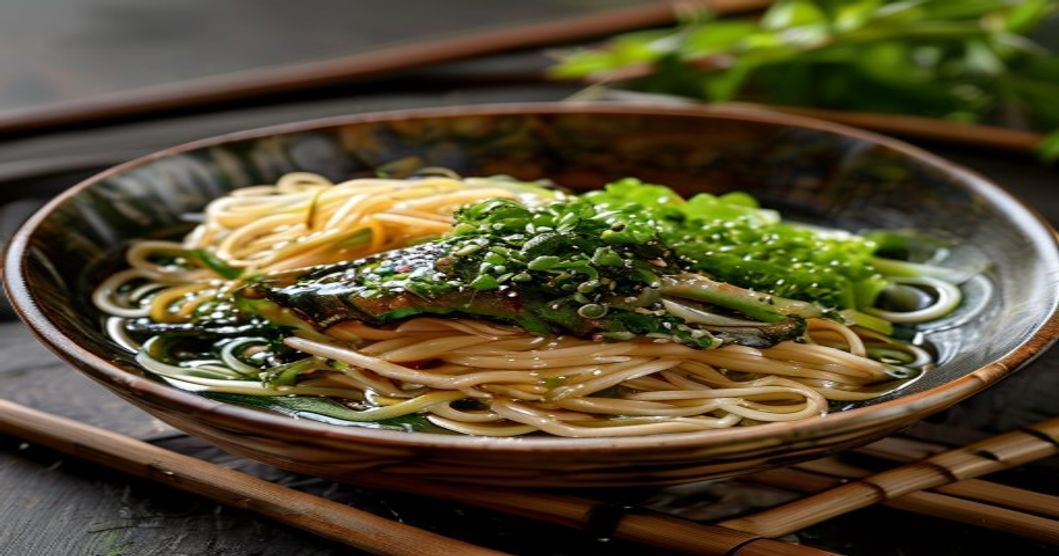
If you are eating udon or white rice as your go-to carbohydrate source in Japan, you are leaving performance on the table. One aisle over in every Japanese supermarket — and in every soba restaurant that costs the same as a convenience store bento — is a carbohydrate source that outperforms both on nearly every metric that matters for athletes.
That carbohydrate is soba. And most people in Japan eat it without any awareness that it is nutritionally exceptional.
What Makes Soba Different
Soba is made from buckwheat flour — and buckwheat is not wheat at all. It is a seed from a flowering plant related to rhubarb, which means it carries a completely different nutritional profile from grain-based noodles.
The key differences:
| Soba (100g cooked) | Udon (100g cooked) | White Rice (100g cooked) | |
| Calories | 99 kcal | 105 kcal | 168 kcal |
| Protein | 4.8g | 2.6g | 2.5g |
| Carbohydrates | 21g | 22g | 37g |
| Fiber | 2.0g | 0.8g | 0.3g |
| GI Score | ~54 (low) | ~80 (high) | ~73 (high) |
Nearly double the protein of udon. Half the glycemic index of white rice. Significantly more fiber than either. For a food that costs the same and takes the same time to prepare, this gap is substantial.
The Rutin Factor
Beyond the macros, buckwheat contains a bioflavonoid called rutin that is rare in most foods and absent from other noodles entirely.
Rutin strengthens capillary walls and improves microcirculation — the network of tiny blood vessels that deliver oxygen and nutrients directly to muscle tissue. For athletes, this means better oxygen delivery during training, faster nutrient transport to recovering muscles, and reduced exercise-induced inflammation at the tissue level.
Rutin also has documented anti-inflammatory and antioxidant properties, which is relevant for anyone training at high volume where oxidative stress accumulates between sessions.
The Amino Acid Profile
Most plant proteins are incomplete — they are missing or low in one or more essential amino acids, which limits their usefulness for muscle protein synthesis. Buckwheat is an exception.
Buckwheat contains all eight essential amino acids, including lysine — the amino acid that is critically low in most grain-based foods including wheat, corn, and rice. Lysine is essential for muscle repair, collagen synthesis, and calcium absorption. The fact that soba provides meaningful lysine content puts it in a different category from virtually every other noodle or grain carbohydrate available in Japan.
Juuwari vs. Niwari: The Buckwheat Percentage Matters
Not all soba is equal. The buckwheat content varies significantly between products:
- Juuwari soba (十割そば): 100% buckwheat flour. Maximum nutritional value. Slightly more crumbly texture, stronger flavor. Found at premium soba restaurants and some supermarkets.
- Niwari soba (二八そば): 80% buckwheat, 20% wheat flour. The most common variety. Still nutritionally superior to udon or white carbs, easier to work with in cooking.
- Cheap blended soba: Some supermarket products use as little as 30-40% buckwheat and fill the rest with wheat. Check the ingredients — buckwheat flour should be listed first.
At a restaurant, juuwari soba will usually be noted on the menu and priced higher. It is worth it if you are eating soba for performance reasons. At the supermarket, look for products with the buckwheat percentage listed prominently on the packaging.
When to Eat It
The low GI score of soba makes it a strong pre-training carbohydrate. Slow-digesting carbs consumed 2-3 hours before training provide sustained energy without the blood sugar spike and subsequent crash that high-GI carbs produce mid-workout.
Post-workout, white rice or higher-GI carbs are often preferable to rapidly replenish glycogen. Soba can work post-training, but it is not the optimal choice if speed of glycogen restoration is the priority.
As an everyday meal carbohydrate — lunch, light dinner, between training days — soba is the clear winner over virtually any alternative available in Japan.
Ordering at a Soba Restaurant
Japanese soba restaurants are fast, cheap, and intimidating to navigate if you do not know what you are looking at. Here is the basic ordering framework:
- Mori soba / Zaru soba: Cold soba served on a bamboo tray with dipping sauce on the side. The purest way to eat soba. Lets you taste the buckwheat directly. Standard portion is around 200 kcal with 10g protein.
- Kake soba: Hot soba in a light dashi broth. Slightly lower protein concentration than cold versions but warming and easy to eat quickly.
- Tororo soba: Soba with grated mountain yam (tororo). Adds fiber, potassium, and digestive enzymes. A solid nutritional upgrade for minimal extra cost.
- Tanuki soba: Soba with tempura bits (tenkasu). Adds fat and calories. Skip if cutting, acceptable if bulking.
The dipping sauce (tsuyu) is high in sodium — do not drink the remaining tsuyu. Adding wasabi and green onion (both provided free at most restaurants) to your tsuyu adds antimicrobial and circulation-supporting compounds for zero extra cost.
Supermarket Soba: The Home Strategy
Dried soba noodles at any Japanese supermarket cost 100-200 yen per serving and cook in 4-5 minutes. This is the most efficient high-protein carbohydrate you can prepare at home in Japan.
A practical high-protein soba meal:
- One bundle dried soba (100g dry) — cooked in 4 minutes
- Two soft-boiled eggs — prepared while soba cooks
- Mentsuyu (concentrated dipping sauce, sold in every supermarket) diluted with cold water as a sauce
- Green onion and sesame seeds from the condiment section
Total preparation time: under 10 minutes. Total protein: approximately 22-24g. Total cost: around 200-250 yen. This is a better post-training meal ratio than most prepared foods available at the same price point in Japan.
The Bottom Line
Japan gives you access to one of the most nutritionally sophisticated carbohydrate sources in the world, available at every supermarket and restaurant for the same price as inferior alternatives.
Soba is not a health food trend. It has been eaten in Japan for over 400 years. The nutritional science simply confirms what Japanese athletes and workers have known by habit: it keeps you fuller longer, performs better for sustained energy, and comes with a protein and micronutrient profile that no other noodle can match.
Switch your default carb. Order the soba.

コメント