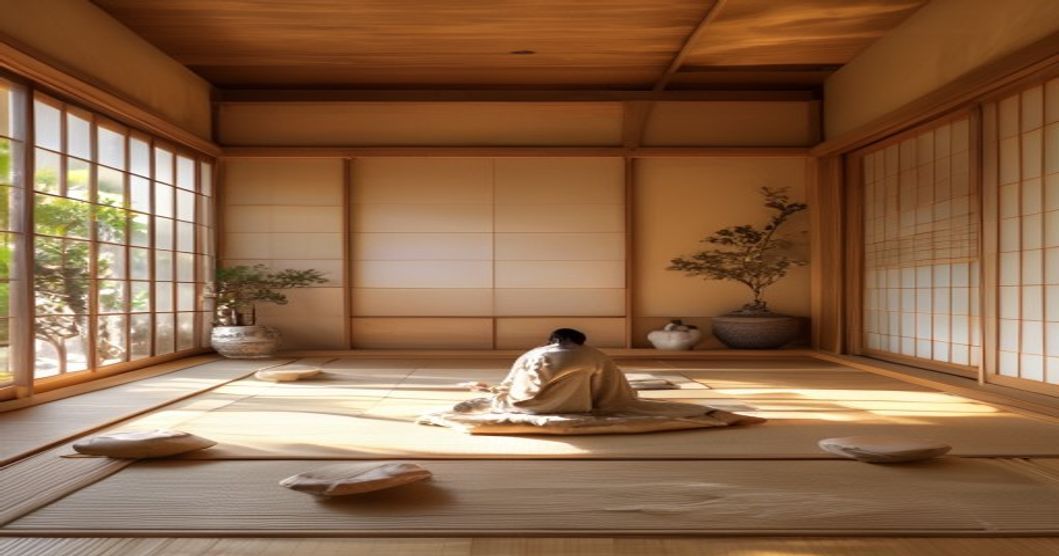
Ask most Western gym-goers to sit cross-legged on the floor for twenty minutes and you will see something interesting: shifting, wincing, one leg going numb, and an eventual retreat back to the chair. Ask a Japanese person the same thing and they will probably just sit down and keep talking.
This difference is not genetic. It is a product of daily habit — specifically, the Japanese practice of living close to the floor. And for anyone serious about mobility, squat depth, and long-term athletic longevity, it is worth understanding exactly what that habit is doing to the body.
What Floor Living Actually Means
Traditional Japanese homes are built around the floor. Low tables (chabudai), floor cushions (zabuton), and futon sleeping mats mean that daily life involves constantly transitioning between standing and seated floor positions. Meals are eaten on the floor. Guests are received on the floor. Sleep happens at floor level.
Modern Japan has largely adopted Western furniture, but the cultural residue remains — floor sitting is still common in homes, at traditional restaurants, and in many social settings. The result is a population that performs dozens of floor-to-standing transitions daily without thinking about it.
The Main Sitting Positions and What They Train
| Seiza (正座) | Kneeling with legs folded underneath. Trains ankle dorsiflexion, knee flexion under load, and upright spinal posture. Demanding on quads and ankles for beginners. |
| Agura (胡坐) | Cross-legged sitting. Opens the hip external rotators, groin, and inner thigh. The position most Westerners struggle with immediately. |
| Yokozuwari (横座り) | Both legs swept to one side. Trains hip internal rotation — the most neglected movement pattern in most Western training programs. |
| Tatehiza (立て膝) | One knee up, one knee down. Asymmetrical hip opener. Trains single-leg stability at the hip. |
Rotating through these positions naturally throughout the day takes every major hip and ankle range of motion through its full arc — repeatedly, under mild load, without any dedicated stretching session required.
Why Western Hips Are Tight
The chair is the primary culprit. Sitting in a chair keeps the hip at approximately 90 degrees of flexion with zero external rotation demand. Do this for eight hours a day, every day of your life, and the tissues adapt: hip flexors shorten, external rotators weaken, and the joint loses range of motion it no longer needs to access.
This matters for athletic performance in direct and measurable ways. Squat depth is limited by hip mobility. Deadlift setup requires posterior chain flexibility that chair-adapted hips simply do not have. Single-leg exercises expose hip instability that years of floor avoidance have created.
The Japanese floor-living habit is, functionally, a passive daily mobility session that prevents exactly this kind of tissue adaptation from occurring.
The Get-Up as a Movement Assessment
Here is a useful diagnostic: sit down on the floor with your arms crossed over your chest, then stand up without using your hands, knees, or forearms for support. This is sometimes called the Sitting-Rising Test, developed by Brazilian physician Claudio Gil Araujo.
The test scores your ability to perform floor-to-standing transitions — the same movement Japanese floor culture demands dozens of times per day. Studies have linked poor performance on this test with reduced longevity, worse balance, and lower muscle quality in aging adults.
Most people who have lived their entire lives in chairs struggle with it. Most people who have grown up in floor-sitting cultures do it without thinking.
How to Start Adding Floor Time
You do not need to renovate your apartment. You need to start spending deliberate time on the floor doing things you would normally do in a chair.
- Watch TV on the floor. Start with agura (cross-legged). When one position becomes uncomfortable, switch to another rather than returning to the couch.
- Eat one meal per day at floor level. Use a low table or just sit with your plate on a cutting board. The meal duration provides consistent hip loading time.
- Work from the floor for short periods. Laptop on a low table, cycling through positions every 15-20 minutes.
- Practice seiza for 5 minutes daily. This will be uncomfortable initially. Ankle and knee flexibility improve rapidly with consistent exposure.
- Do your post-workout stretching on the floor rather than a bench or mat raised off the ground. Floor proximity changes the available movement options.
The Carry-Over to Training
Consistent floor living produces measurable improvements in the movement patterns that matter most in the gym:
- Squat depth improves as hip external rotation and ankle dorsiflexion increase
- Deadlift setup becomes easier as posterior chain flexibility allows a better starting position
- Single-leg stability improves as the hip external rotators — trained by agura — get stronger
- Overhead work benefits from the improved thoracic extension that seiza’s upright posture demands
These are not minor quality-of-life improvements. They are the exact movement deficiencies that cause most recreational athletes to plateau, get injured, or spend years on mobility work without addressing the root cause: they simply never use those ranges of motion in daily life.
The Tatami Principle
Japanese floor culture is built on tatami — woven rush grass mats that cover the floor of traditional rooms. The tatami room is a space where shoes come off, posture changes, and the body operates closer to the ground.
You do not need tatami. You need the same principle: a designated floor space where you spend time daily, without furniture mediating your relationship with the ground.
Clear a corner of your room. Put down a mat. Sit there for thirty minutes tonight while you read or watch something. That is the entire starting point.
Japan has been doing passive hip mobility work for centuries. They just call it sitting at home.


コメント