What if the most powerful weight-management tool on earth isn’t a supplement, a macro split, or an intermittent fasting protocol — but a 2,500-year-old phrase you say before every meal? In Okinawa, one of the world’s longest-lived populations swears by exactly that.
What Is Hara Hachi Bu?
Pronounced hah-rah hah-chee boo, 腹八分目 literally translates to “stomach 80% full.” It’s a Confucian teaching that took deepest root in Okinawan culture, where residents recite it as a mealtime mantra — a mindful brake applied before the plate is clean.
Where It Comes From
The phrase traces back to Confucian texts from around 500 BCE, later adopted into Japanese dietary philosophy during the Edo period. Okinawa absorbed it into daily ritual so thoroughly that it became less a rule and more a reflex — passed from grandparents to grandchildren at the dinner table for generations.
The Science Behind Stopping Early
Here’s the biological catch most Western eating habits ignore: your gut and brain communicate on a 15–20 minute delay. By the time your brain registers fullness, you’ve already overeaten. Hara Hachi Bu exploits this lag deliberately — stopping at 80% gives your hormones time to catch up.
Research into calorie restriction consistently shows that eating 10–25% fewer calories without malnutrition slows cellular aging markers and reduces inflammation. Traditional Okinawan elders consumed an estimated 11% fewer calories than their intake required for full satiety — almost certainly due to Hara Hachi Bu. The hunger hormone ghrelin drops after eating, while leptin — your satiety signal — rises slowly. Eating past fullness overrides leptin sensitivity over time. Hara Hachi Bu trains it back.
The Blue Zone Connection
Okinawa is one of Dan Buettner’s original five Blue Zones — regions where people routinely live past 100. Researchers identified Hara Hachi Bu as a core longevity behavior, directly linked to lower rates of obesity and cardiovascular disease. The average Okinawan centenarian has a BMI in the normal range — not from calorie counting, but from a lifelong habit of pausing.
How Okinawans Actually Do It
- They eat from smaller bowls, making portions visually satisfying at lower volumes.
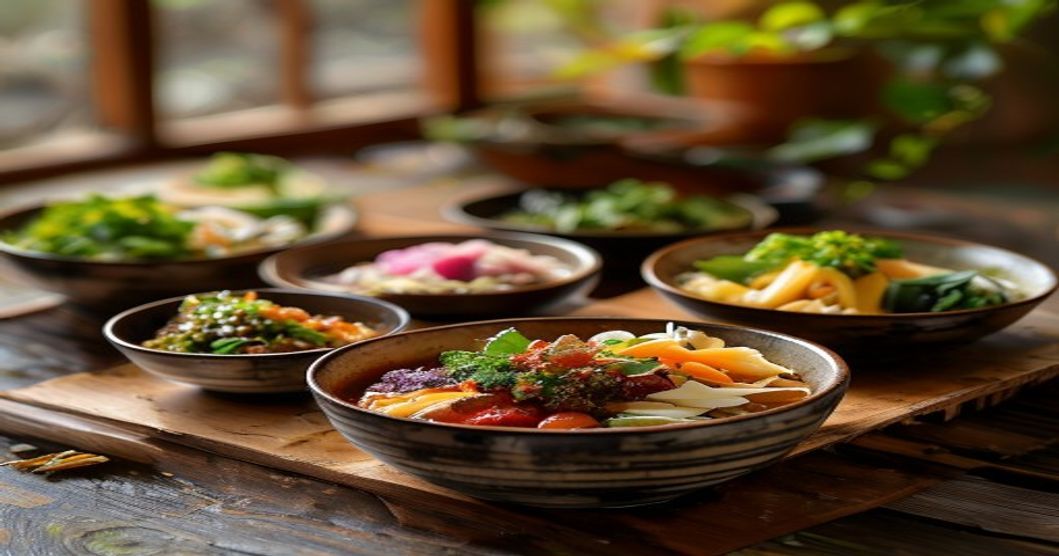
- Meals are slow and served in multiple small dishes rather than one large plate.
- They pause mid-meal — conversation is part of eating, not a distraction from it.
- Many older Okinawans still say the phrase aloud before eating, as a conscious reset.
How to Apply It Starting Tonight
- Eat without screens. Distraction kills your ability to read internal hunger cues.
- Halve your pace. Put your fork down between bites. Chew fully.
- Check in at the halfway point. Ask: could I stop now and be okay?
- Use a smaller plate. A full small bowl beats a half-empty large one.
- Wait 10 minutes before seconds. Most times, you won’t want them.
For fitness enthusiasts: this isn’t about under-fueling training. Apply Hara Hachi Bu to everyday eating — not pre- or post-workout nutrition.
Try It for One Week
No app. No food scale. No macros. Just stop at 80% — and wait. Track how you feel at the end of each day for seven days. The Okinawans have been running this experiment for centuries. The results are written in their lifespans.


コメント